Best Smart Dishwasher 2026: 5 Wi-Fi Models Compared
Bosch Series 6, Miele G 7000 AutoDos, Siemens iQ500, LG QuadWash, Haier hOn: which smart dishwasher should you buy in 2026? EU energy label A–G, noise, place settings, auto-dosing and what the app is really good for.

Quick answer
What is the best smart dishwasher in 2026?
- View on Amazon →
Best overall
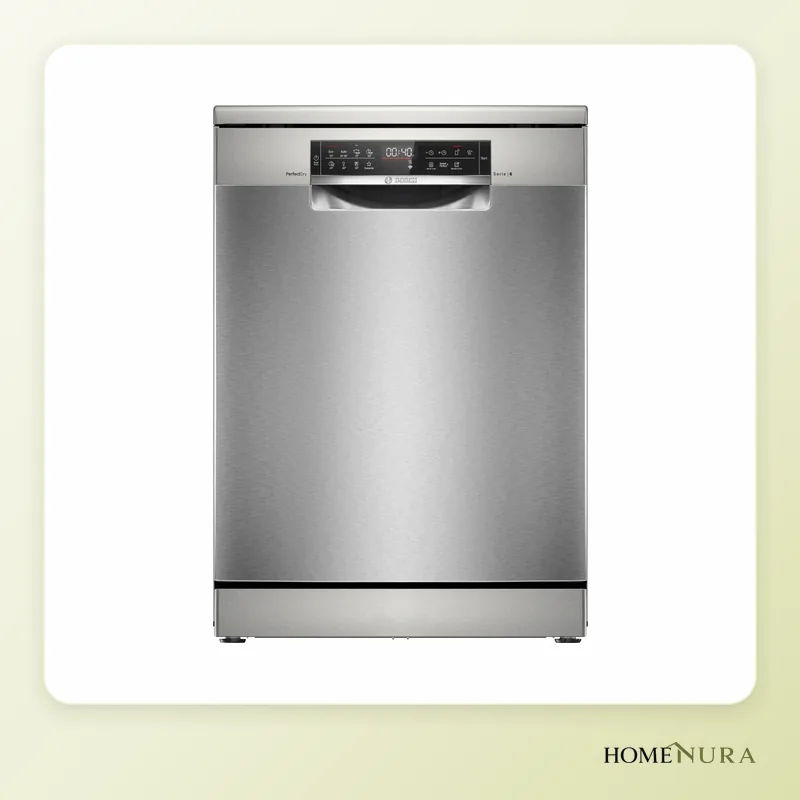
Bosch Serie 6 SMS6ZCI42E
Zeolite drying that even dries plastics, a third rack, 14 place settings, 44 dB and a full-featured Home Connect app.
Photo: © Bosch (BSH Hausgeräte)
- View on Amazon →
Best value
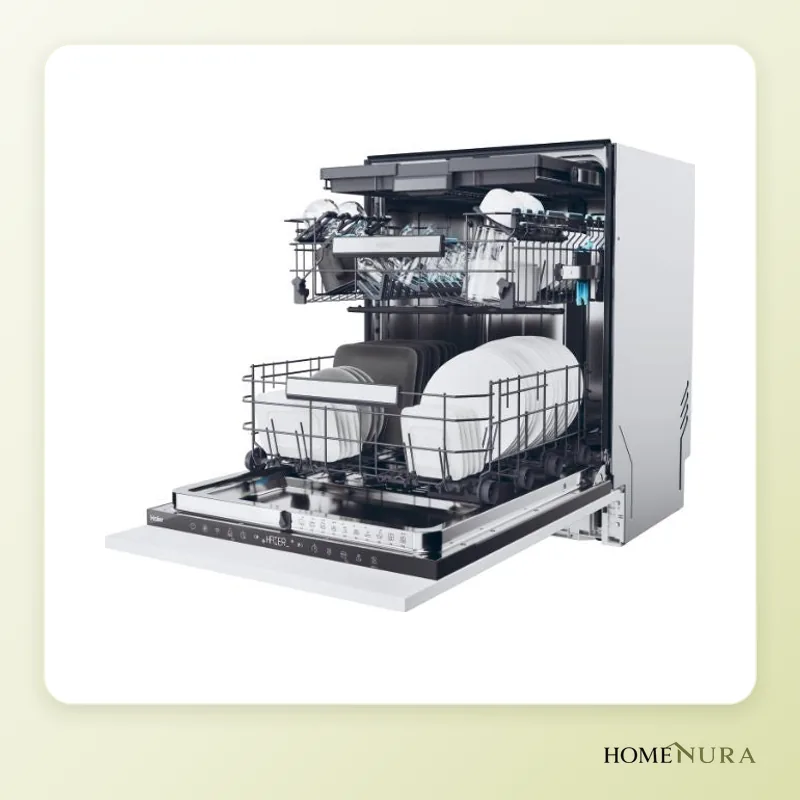
Haier XS 6B0S3FSB
A panel-ready model with 16 place settings, EU class B and 40 dB, automatic door opening and the hOn app, priced well below the German brands.
Photo: © Haier
- View on Amazon →
Best for auto-dosing
Miele G 7110 SC AutoDos
AutoDos doses detergent automatically from a PowerDisk cartridge, EU class B, 43 dB, AutoOpen drying and the Miele@home app.


As an Amazon Associate I earn from qualifying purchases. Amazon affiliate links: commission at no extra cost to you.
The best smart dishwasher in 2026 for most households is the Bosch Series 6 SMS6ZCI42E: 14 place settings, zeolite drying, a third rack, 44 dB and a full-featured Home Connect app. If you never want to measure detergent again, the Miele G 7110 SC AutoDos is the most polished option; for a built-in look on a tighter budget, the panel-ready Haier XS 6B0S3FSB offers 16 place settings at 40 dB.
This comparison is based on manufacturer specification sheets, official EU energy label data (the EPREL database), reviews published by specialist outlets and verified buyer feedback. It covers five brands and their app ecosystems: Home Connect (Bosch, Siemens), Miele@home, LG ThinQ and Haier hOn. Models and versions sold in Canada can differ from the European ones: check that the listing is for a 120 V North American model. To browse the full range, see our smart dishwashers section.
The buying criteria that really matter
The A–G energy label (2021 version)
Since March 1, 2021, the EU dishwasher energy label has been rescaled: the old A+++ to D classes were replaced by a much stricter A to G scale. A machine that used to be A+++ is often rated C or D today. In practice, a B or C rating is already a good result, and class A remains rare. The label also shows energy use in kWh per 100 Eco cycles, water per cycle, Eco program duration, the number of place settings, and noise with its own class (A to D). A QR code links to the model’s official sheet in the EU EPREL database. Canada uses the EnerGuide label for major appliances, so the EU class won’t appear on Canadian packaging.
Noise in decibels
In an open-concept kitchen, this is the spec people most regret ignoring. Below 42 dB a dishwasher is discreet; around 44 dB it’s acceptable; above 46 dB you’ll clearly hear it during a conversation. Many models also offer a quiet program (around 39 dB) for overnight runs.
Place settings
A standard 60 cm (24 in.) dishwasher holds 13 to 14 place settings, which suits a family of four. Models with 15 or 16 place settings gain space through a taller tub and an optimized third rack: worthwhile if you cook a lot or prefer to run one load a day.
Freestanding or panel-ready
A freestanding model has its own finished casing and top; many, like the Bosch in this guide, can slide under a counter once the top is removed. A panel-ready (fully integrated) model hides behind a cabinet door panel, sold separately. Measure your space (width, height, depth) before buying anything.
Auto-dosing
Auto-dosing stores detergent for several weeks and releases the right amount for each cycle. Miele does this with AutoDos and its PowerDisk cartridges. The other models here use a conventional detergent dispenser, with a dosing assistant on the Bosch and Siemens. The benefit: no more overdosing and white residue. The catch: a brand-specific consumable.
Third rack and Eco program duration
A third rack (cutlery drawer) frees up the lower rack and makes cutlery and utensils easier to load. As for the Eco program, it often runs between 3 and 4 hours, and that’s normal. EU rules make it the reference program, and it saves energy precisely by washing longer at a lower temperature.
What the app is really useful for
- Remote start: load in the morning, start from the office or during off-peak hours. On most models you must enable remote start on the machine itself, with the door closed.
- Consumable alerts: salt, rinse aid, and detergent level on auto-dosing models.
- Diagnostics: error codes explained, troubleshooting tips, and sometimes data shared with the service department.
- Program assistant: the app recommends a cycle based on the load and how dirty it is.
- Consumption tracking and software updates.
The app doesn’t wash any better, though: a smart dishwasher works perfectly well without a smartphone.
Models mentioned in this guide
- Miele G 7110 SC AutoDosView on Amazon →
- Siemens iQ500 SN65ZX07CEView on Amazon →
- LG DF455HSSView on Amazon →
Photos: © Bosch (BSH Hausgeräte), © Haier
As an Amazon Associate I earn from qualifying purchases. Amazon affiliate links: we earn a commission at no extra cost to you.
The 5 best smart dishwashers in 2026
1. Bosch Series 6 SMS6ZCI42E: best overall
The Bosch Series 6 SMS6ZCI42E is a 60 cm (24 in.) freestanding model in anti-fingerprint stainless steel, rated C, with 14 place settings, 44 dB and an Eco 50°C program lasting 3 h 55 min. Its standout feature is PerfectDry zeolite drying: a mineral that releases heat and dries plastics too, a weak point for many competitors.
- Strengths: excellent drying, VarioDrawer third rack, ExtraClean zone for pots and pans, AquaStop leak protection with a lifetime warranty from Bosch, rich Home Connect app (remote start, Silence on demand, program suggestions).
- Limitations: only class C, 9.5 litres per Eco cycle, no auto-dosing.
- Best for: families who want dishes that come out dry, with no towel-drying, and a reliable app, without committing to a proprietary consumable.
2. Miele G 7110 SC AutoDos: best for hands-free dosing
The Miele G 7110 SC AutoDos belongs to the G 7000 series. Freestanding, 14 place settings, class B (64 kWh per 100 cycles), 8.4 litres of water per Eco cycle and 43 dB. Its AutoDos system draws from a PowerDisk cartridge in the door, which Miele says lasts about 20 cycles.
- Strengths: built-in auto-dosing, automatic door opening (AutoOpen) for drying, 3D MultiFlex cutlery tray, QuickPowerWash in under an hour, ExtraQuiet program at 39 dB, optional hot-water connection. The Miele@home app shows fill levels, a consumption dashboard, push notifications and a diagnostics assistant.
- Limitations: premium model, Miele-only PowerDisk cartridges, 3 h 19 min Eco program.
- Best for: buyers who want a machine built to last (Miele says its components are designed for the equivalent of 20 years of use) and never want to think about dishwasher pods again.
3. Siemens iQ500 SN65ZX07CE: best panel-ready
The Siemens iQ500 SN65ZX07CE is a 60 cm (24 in.) panel-ready dishwasher, class B, 14 place settings, with a 3 h 35 min Eco program and just 40 dB (39 dB in the Silence program). It shares the zeolite drying of the Bosch-Siemens platform.
- Strengths: very quiet, zeolite drying, varioDrawer, remote start and extra options in the Home Connect app (HygienePlus, Silence on demand), aquaStop.
- Limitations: you need a matching cabinet door panel, installation is more involved than for a freestanding unit, no auto-dosing.
- Best for: a kitchen with custom cabinetry that opens onto the living room, where silence and a seamless look come first.
4. LG QuadWash Steam DF455HSS: best for steam hygiene
The LG DF455HSS is a 60 cm (24 in.) freestanding model, class C, with 14 place settings across three EasyRack Plus racks and 41 dB thanks to its Inverter Direct Drive motor. It stands out with QuadWash, multi-motion spray arms, and TrueSteam, a steam phase that helps loosen residue and reduce spotting on glasses.
- Strengths: very quiet for a freestanding unit, automatic door opening at the end of the cycle, LG ThinQ app (remote start, cycle monitoring, downloadable programs, diagnostics).
- Limitations: class C, 9.5 litres per cycle, no auto-dosing.
- Best for: homes already using LG ThinQ, or that wash a lot of glassware and baby bottles.
5. Haier XS 6B0S3FSB: best capacity for the money
The Haier XS 6B0S3FSB (Washlens Plus range) is a 60 cm (24 in.) panel-ready dishwasher that holds 16 place settings, rated B, with 40 dB and a 3 h 55 min Eco program. It sits well below the German brands in price.
- Strengths: large capacity thanks to its Maxi tub, third rack, fold-down tines, brushless inverter motor, automatic door opening, hOn app with Shoot&Wash, which recommends a program from a photo of the load.
- Limitations: a smaller service network than Bosch or Miele, no auto-dosing.
- Best for: large families outfitting a kitchen with built-in appliances on a set budget.
Comparison table
| Model | Installation | Place settings | Energy class | Noise | Eco duration | App | Best for |
|---|---|---|---|---|---|---|---|
| Bosch Series 6 SMS6ZCI42E | Freestanding | 14 | C | 44 dB | 3 h 55 min | Home Connect | Drying, family use |
| Miele G 7110 SC AutoDos | Freestanding | 14 | B | 43 dB | 3 h 19 min | Miele@home | Auto-dosing, longevity |
| Siemens iQ500 SN65ZX07CE | Panel-ready | 14 | B | 40 dB | 3 h 35 min | Home Connect | Open-concept kitchen, silence |
| LG DF455HSS | Freestanding | 14 | C | 41 dB | n/a | LG ThinQ | Steam hygiene, glassware |
| Haier XS 6B0S3FSB | Panel-ready | 16 | B | 40 dB | 3 h 55 min | Haier hOn | Large family, budget |
Mistakes to avoid
- Mixing up freestanding and panel-ready: a panel-ready model has no finished door of its own, and a freestanding one can’t hide behind a cabinet panel.
- Treating class C as poor: on the 2021 EU scale, C is a good level. Compare the kWh per 100 cycles shown on the label instead.
- Avoiding the Eco program because it’s long: it’s the most economical. Use delay start or remote start so it runs while you’re out.
- Overdosing detergent: it leaves deposits and wears out seals. An auto-dosing model solves the problem.
- Buying for the app alone: check noise, capacity and drying first; connectivity is a bonus.
- Forgetting salt and rinse aid if your water is hard: this is exactly what the app alerts are for.
Installation, use and safety
A dishwasher connects to a cold water supply (or hot water for some Miele models), a drain and a grounded outlet, ideally on a dedicated circuit. Avoid extension cords and power bars. If an outlet or circuit has to be added, hire a licensed electrician (electrical work rules are set by each province and territory); for a panel-ready model, an installer will adjust the door panel and fit the steam-protection strip under the countertop.
Leak protection systems such as AquaStop shut off the water supply if something goes wrong, but a smart water leak detector under the sink adds a useful extra layer. On the app side, Wi-Fi setup takes a few minutes; keep the software up to date and only enable remote start once the door is properly closed. For more ways to save, read our smart home energy-saving guide.
Verdict
The Bosch Series 6 SMS6ZCI42E remains the most balanced choice: zeolite drying, a third rack and a mature Home Connect app. The Miele G 7110 SC AutoDos is the premium pick for anyone who wants auto-dosing and proven longevity. Behind custom cabinetry, the Siemens iQ500 SN65ZX07CE shines for its silence, while the Haier XS 6B0S3FSB offers 16 place settings at a sensible price. The LG DF455HSS will appeal to fans of steam cleaning and the ThinQ ecosystem.
Frequently Asked Questions
Is a smart dishwasher really worth it?
Is a class C dishwasher energy-hungry?
Why does the Eco program take almost 4 hours?
Is Miele’s AutoDos auto-dosing worth it?
Does a smart dishwasher work without Wi-Fi?
How many place settings does a family need?
Article from our comprehensive guide
Cleaning & Home Care →Our recommendations
- Miele G 7110 SC AutoDosView on Amazon →
- Siemens iQ500 SN65ZX07CEView on Amazon →
- LG DF455HSSView on Amazon →
Photos: © Bosch (BSH Hausgeräte), © Haier
As an Amazon Associate I earn from qualifying purchases. Amazon affiliate links: we earn a commission at no extra cost to you.


