Heat Pump Dryer Comparison 2026: 6 Models on the New EU A–G Label
Which heat pump dryer should you buy in 2026? Bosch Series 8, Siemens iQ700, AEG 9000X, Samsung, Miele T2 and Beko compared on the new EU A–G energy label in force since July 2025: consumption, noise, condensation, capacity and app.

Quick answer
What is the best heat pump dryer in 2026?
- View on Amazon →
Best overall
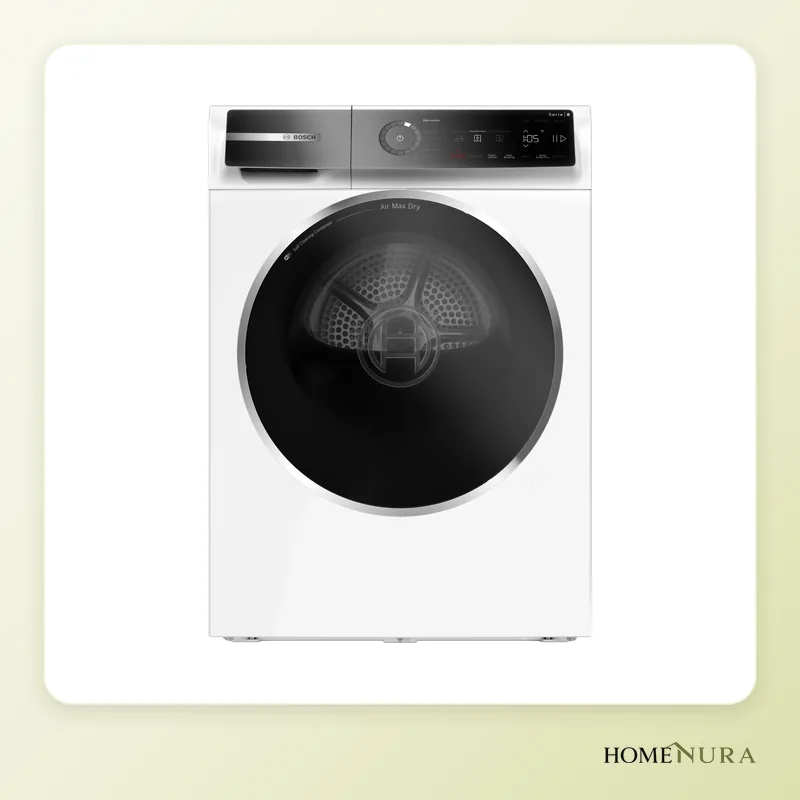
Bosch Serie 8 WRB247C40
Class A on the new EU label (79 kWh/100 cycles), 57 dB, condensation class A and a self-cleaning condenser: efficient, quiet and nearly maintenance-free.
Photo: © Bosch (BSH)
- View on Amazon →
Best value
Beko B7T88209
EU energy class A and condensation class A with SteamCure steam, in a much more affordable price tier; 8 kg suits couples and small families.
- View on Amazon →
Best for longevity
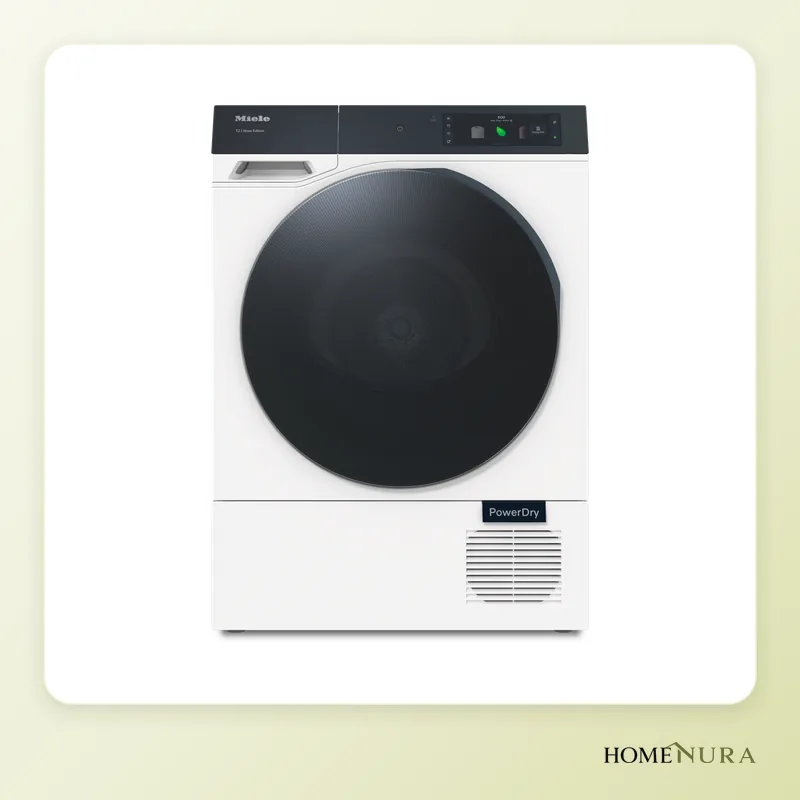
Miele TQ 1000 WP Nova Edition
EU energy class B but class A for noise and condensation, SteamCare steam, WoolDry and Miele build quality, designed by the brand for 20 years of use.
Photo: © Miele


As an Amazon Associate I earn from qualifying purchases. Amazon affiliate links: commission at no extra cost to you.
The best heat pump dryer in 2026 for most households is the Bosch Series 8 WRB247C40: 9 kg, energy class A on the new EU label, 57 dB, condensation efficiency A and a self-cleaning condenser. If you want to spend less, the Beko B7T88209 (8 kg, class A) is the most economical alternative, and if you want a machine built to last for many years, the Miele TQ 1000 WP Nova Edition (9 kg, class B, steam function) is the strongest choice.
This comparison is based on manufacturer spec sheets, the EU energy label and verified buyer feedback. One key point before you buy: since July 1, 2025, dryers sold in the EU carry a new energy label on an A to G scale. Old ratings such as "A+++" can no longer be compared directly, which has caused a lot of confusion in European stores. Canada uses the EnerGuide label for major appliances, so the EU class won't appear on Canadian packaging. You will also find every model in our smart washers and dryers section.
The new EU energy label for dryers (since July 2025)
In the EU, washing machines and dishwashers moved to the A–G scale in 2021; dryers followed on July 1, 2025. The plus classes are gone, and the thresholds are so demanding that many dryers once sold as A+++ now land in class C. A dryer rated B or C is therefore not a poor appliance; it is simply graded under stricter rules. Only a handful of heat pump dryers reach class A so far.
The new label shows much more than the class:
- Energy use in kWh per 100 cycles on the Eco program (a weighted value of full and half loads). This is the best figure for comparing two models.
- Rated capacity in kg and the Eco program duration at full load, often three to four and a half hours on a heat pump dryer.
- A condensation efficiency class (A to D): how much moisture ends up in the tank rather than in the room.
- Noise in dB(A), with a noise class from A to D.
- A repairability class (A to E), showing how easy the appliance is to repair.
- A QR code linking to the product sheet in the EU's EPREL database.
Stricter EU ecodesign requirements have also applied since July 2025. In practice, almost only heat pump models meet them, which is why classic condenser dryers with a heating element are disappearing from European stores. Be careful with clearance stock and used units: they often still carry the old A+++ label, which cannot be compared with the new one.
Models mentioned in this guide
- Beko B7T88209View on Amazon →
- AEG 9000X TR9XW80890View on Amazon →
- Samsung DV90F09F4SU2View on Amazon →
Photos: © Bosch (BSH), © Miele
As an Amazon Associate I earn from qualifying purchases. Amazon affiliate links: we earn a commission at no extra cost to you.
What really matters when buying
Consumption in kWh, not just the class
Models in the same class still differ. The class A models in this comparison use about 79 kWh per 100 cycles (Bosch, Siemens, AEG, Samsung), and the class B Miele 92 kWh. At 100 to 200 cycles a year, the difference between A and B is real but modest. The gap is far bigger against an old condenser dryer without a heat pump: Bosch quotes savings of up to roughly three quarters for the WRB247C40 compared with conventional dryers.
Capacity
For one or two people, 7 to 8 kg is enough; for a family, 9 kg is the right size. Simple rule: the dryer should take at least the same load as your washing machine, or you will have to split loads. A large drum that usually runs half empty is less efficient.
Noise and condensation efficiency
Between 57 and 60 dB(A), a dryer counts as quiet. If it sits near a bedroom or in an open-concept kitchen, aim for noise class A. Condensation efficiency matters most if the dryer is in a bathroom or a small room without a window: class A means less moisture released into the air.
Self-cleaning condenser
The heat exchanger in a heat pump dryer loses efficiency as lint builds up on it. On Bosch and Siemens, a self-cleaning condenser rinses it several times per cycle, keeping consumption stable over the years. Without this feature, you need to clean the filters or condenser by hand regularly.
Sensors, programs and steam
Moisture sensors stop the cycle as soon as the chosen dryness level is reached, which prevents over-drying. Wool, sports/outdoor and quick programs, plus a steam function that reduces wrinkles and makes ironing easier, are the most useful extras.
The app: handy, not essential
The app tells you when the cycle ends, reminds you to clean the filter and lets you schedule a start, for example when your solar panels are producing. Bosch and Siemens use Home Connect, Miele its Miele app, Samsung SmartThings and AEG its own app over Wi-Fi. The Beko connects to HomeWhiz via Bluetooth, so only when you are close to the appliance.
The 6 heat pump dryers compared
1. Bosch Series 8 WRB247C40: best overall
The WRB247C40 is one of the few dryers rated A on the new label: 79 kWh per 100 cycles, 57 dB(A) in noise class A, condensation efficiency A and, according to its spec sheet, repairability class A. Its self-cleaning condenser keeps the heat exchanger free of lint, and it uses the natural refrigerant R290.
Strengths: top marks in every label category, very quiet, almost no condenser maintenance, Home Connect with remote start and energy management.
Limitations: the Eco program takes about four and a half hours at full load according to the spec sheet; positioned at the premium end.
Who it's for: families who dry a lot and want a quiet, efficient, low-maintenance machine.
2. Siemens iQ700 WR47B2C40: the same technology, different badge
Siemens and Bosch belong to the same group, and it shows in the spec sheet: the WR47B2C40 also reaches class A with 79 kWh per 100 cycles, 57 dB(A), condensation efficiency A and a self-cleaning condenser. The differences are mainly in design, interface and program names.
Strengths: same efficiency and quietness as the Bosch, Home Connect.
Limitations: equally long Eco program; no technical advantage over the Bosch.
Who it's for: anyone who already owns a Siemens washing machine or finds a better deal on this model.
3. AEG 9000X TR9XW80890: for wool and delicates
AEG's 9000X range scores three As: energy efficiency (79 kWh per 100 cycles), condensation efficiency (94%) and noise class, at 60 dB(A). Its 3D Scan technology measures moisture even inside bulky items such as down jackets and duvets, and SmartDry lets you favour time or energy. The wool program is Woolmark certified.
Strengths: very even drying of thick textiles, excellent condensation, Wi-Fi app control, inverter motor.
Limitations: slightly louder than the Bosch and Siemens; premium-priced, with features that pay off mainly for delicate laundry.
Who it's for: households that dry a lot of wool, down or technical clothing.
4. Samsung DV90F09F4SU2: comfort and a big screen
This 9 kg Samsung is rated A (about 0.79 kWh per cycle) at 60 dB(A) in noise class A. Its condensation efficiency is 88%, which is class B. It stands out with a 7-inch colour display; automatic fabric recognition adjusts the cycle, and the QuickDrive option shortens drying times. It is controlled through SmartThings, including by voice.
Strengths: class A, plenty of convenience features, mature app, ten-year warranty on the inverter motor according to the manufacturer.
Limitations: condensation only class B; more features than most people will use.
Who it's for: smart home fans who already own Samsung devices.
5. Miele TQ 1000 WP Nova Edition: the long-term investment
This Miele T2 dryer is class B at 92 kWh per 100 cycles, but noise class A (60 dB(A)) and condensation efficiency A. It offers the M Touch Pro colour display, SteamCare against wrinkles, WoolDry for wool, the FragranceDos scent system and QuickPowerDry, which Miele says dries 4 kg of easy-care laundry in 49 minutes. Miele states that it designs its appliances for 20 years of use.
Strengths: premium build, gentle laundry care, steam and fragrance, Miele@home connectivity.
Limitations: only class B; clearly more expensive than the other models.
Who it's for: buyers who would rather invest once and keep the appliance for a very long time.
6. Beko B7T88209: class A on a smaller budget
The Beko B7T88209 is a little smaller at 8 kg but also reaches energy class A and condensation efficiency A. It adds SteamCure against wrinkles, an inverter motor, a large door opening and hygiene programs. The HomeWhiz app connects via Bluetooth.
Strengths: top energy class in the entry and mid-range segment, steam function.
Limitations: only 8 kg; app limited to Bluetooth range; a less extensive after-sales network in Europe than the German brands.
Who it's for: couples and small families who want efficient drying without a big budget.
Comparison table
| Model | Capacity | Energy class (kWh/100 cycles) | Noise | Condensation | App | Best for |
|---|---|---|---|---|---|---|
| Bosch Series 8 WRB247C40 | 9 kg | A (79) | 57 dB (A) | A | Home Connect | Best overall |
| Siemens iQ700 WR47B2C40 | 9 kg | A (79) | 57 dB (A) | A | Home Connect | Siemens households |
| AEG 9000X TR9XW80890 | 9 kg | A (79) | 60 dB (A) | A (94%) | AEG app | Wool, down |
| Samsung DV90F09F4SU2 | 9 kg | A (approx. 79) | 60 dB (A) | B (88%) | SmartThings | Smart home |
| Miele TQ 1000 WP Nova Edition | 9 kg | B (92) | 60 dB (A) | A | Miele@home | Longevity |
| Beko B7T88209 | 8 kg | A | n/a | A | HomeWhiz (Bluetooth) | Value |
Mistakes to avoid
- Comparing old and new labels: a clearance "A+++" model is not more efficient than a new class B model. Compare kWh per 100 cycles.
- Looking only at the class: capacity, noise and condensation efficiency often matter more day to day.
- Choosing a drum that is too small: match at least the capacity of your washing machine.
- Ignoring the spin speed: the drier your laundry leaves the washer, the shorter and cheaper the drying cycle. 1,400 rpm is a good baseline.
- Forgetting the lint filter: a clogged filter lengthens the cycle and raises consumption. Clean it after every load.
- Emptying the tank instead of using the drain hose: if a drain is nearby, hook up the drain hose so you don't have to empty the tank after every cycle.
Installation, use and safety
A heat pump dryer needs no outside vent, so it can go in a laundry room, bathroom or basement. The room should not be too cold, though, as the heat pump loses efficiency at low temperatures; the permitted ambient temperature range is listed in the manual. Leave some space around the appliance so heat can escape.
To stack a washer and dryer, use the manufacturer's stacking kit so the dryer cannot slide off with vibrations. Plug the dryer directly into a grounded wall outlet, never into a power bar or extension cord. Many recent models, including the Bosch, Siemens and Miele dryers listed here, use the natural refrigerant R290 (propane). It is better for the climate but flammable: any work on the refrigerant circuit must be left to the manufacturer's service or a qualified technician.
If you prefer to air-dry, a dehumidifier keeps indoor moisture under control; see our smart dehumidifier guide. To pick a matching washing machine, read our smart washing machine comparison.
Verdict: which heat pump dryer should you choose?
The Bosch Series 8 WRB247C40 is the most balanced heat pump dryer of 2026: class A, very quiet, condensation A and almost maintenance-free thanks to its self-cleaning condenser. The Siemens iQ700 WR47B2C40, built on the same technology, is an equivalent alternative. For wool and down, the AEG 9000X makes a strong case, and for smart home fans, the Samsung DV90F09F4SU2. If longevity and laundry care come first, choose the Miele TQ 1000 WP Nova Edition; to buy smart on a budget, the Beko B7T88209 is the right call. Whatever you pick, compare models on the new EU label and check consumption in kWh per 100 cycles.
Frequently Asked Questions
Why is my A+++ dryer now rated class C?
How much electricity does a heat pump dryer use?
Why does a drying cycle take so long?
Can a heat pump dryer go in a cold room?
Do I need a self-cleaning condenser?
Can I stack the dryer on top of the washing machine?
Article from our comprehensive guide
Cleaning & Home Care →Our recommendations
- Beko B7T88209View on Amazon →
- AEG 9000X TR9XW80890View on Amazon →
- Samsung DV90F09F4SU2View on Amazon →
Photos: © Bosch (BSH), © Miele
As an Amazon Associate I earn from qualifying purchases. Amazon affiliate links: we earn a commission at no extra cost to you.


