Best Smart Essential Oil Diffusers of 2026: Wi-Fi, App and Voice Picks
Asakuki, Maxcio, Zen’Arôme Prague, Atomiser Connect, Levoit Dual 200S: which smart essential oil diffuser should you buy in 2026? Ultrasonic vs. nebulizer, Wi-Fi vs. Bluetooth, Alexa or Apple Home, plus safety tips for kids, pregnancy and cats.

Quick answer
What is the best smart essential oil diffuser in 2026?
- View on Amazon →
Best overall
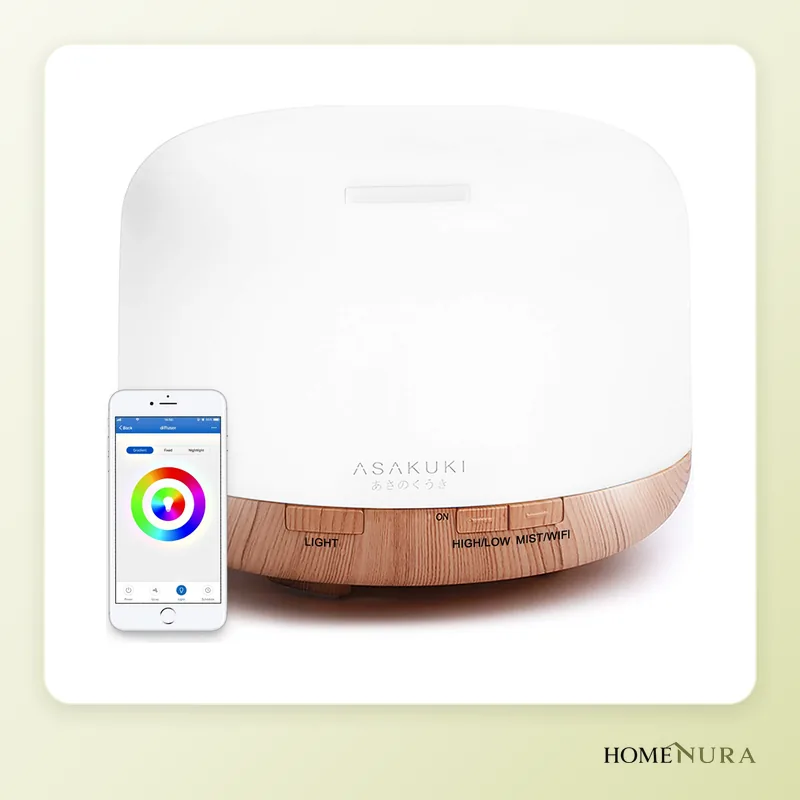
ASAKUKI Smart Wi-Fi Essential Oil Diffuser 500ml
A 17 fl oz (500 ml) tank, full scheduling through Tuya Smart, and voice control with Alexa and Google Home.
Photo: © ASAKUKI
- View on Amazon →
Best value
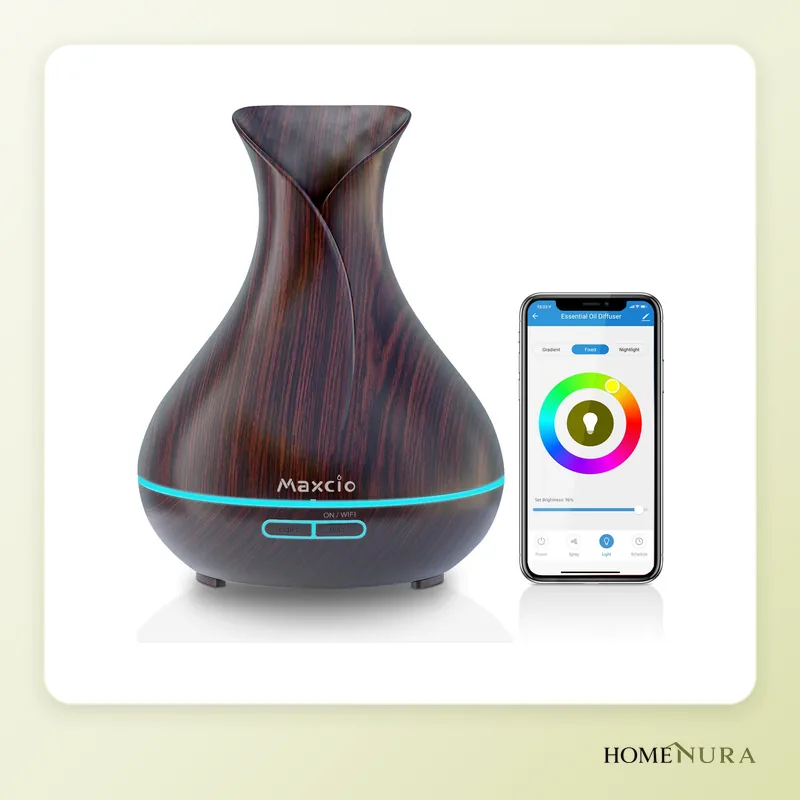
Maxcio Smart Essential Oil Diffuser 400ml
Entry-level but complete: a 14 fl oz (400 ml) tank, the Smart Life app, Alexa, Google Home and a timer.
Photo: © Maxcio
- View on Amazon →
Best smart nebulizer
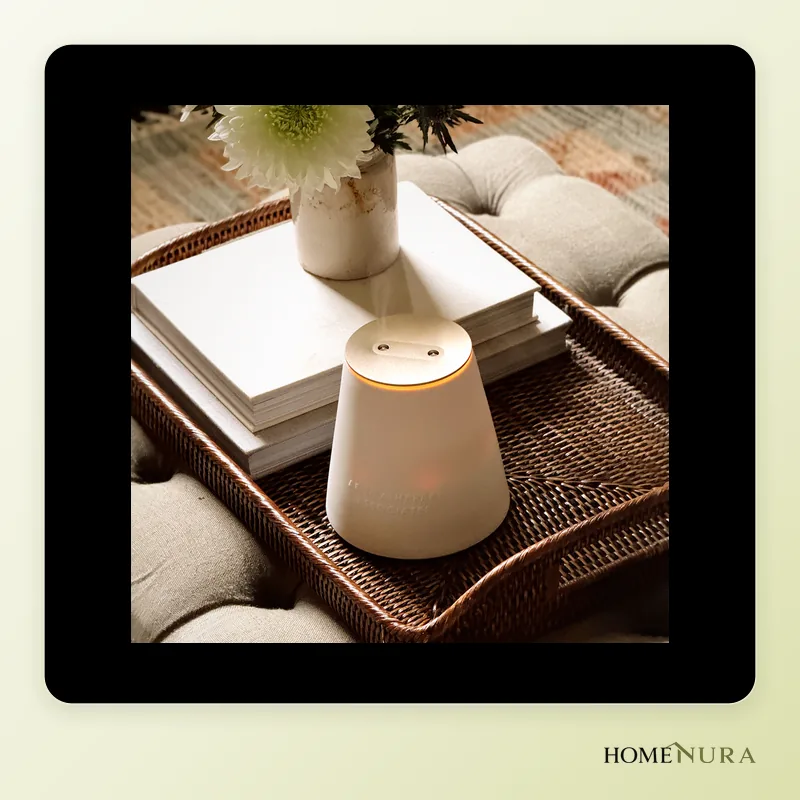
Aromatherapy Associates Atomiser Connect
Waterless pure-oil diffusion, two diffuser heads for two blends and scheduling through a Bluetooth app.
Photo: © Aromatherapy Associates


As an Amazon Associate I earn from qualifying purchases. Amazon affiliate links: we earn a commission at no extra cost to you.
For most homes in 2026, the best smart essential oil diffuser is the ASAKUKI Smart Wi-Fi Essential Oil Diffuser: a 17 fl oz (500 ml) ultrasonic model you control from an app, compatible with Alexa and Google Home, that runs a whole evening without a refill. If budget comes first, the Maxcio 400 ml covers the essentials, and if you’d rather diffuse pure oils without water, the Aromatherapy Associates Atomiser Connect is one of the few nebulizers you can control from your phone.
This comparison is based on manufacturer specs, European retailer listings, published independent reviews and verified owner feedback. We clearly separate the models that are genuinely smart from the ones that aren’t, and we finish with safety precautions, which matter a lot with essential oils.
Smart diffusers: what the app actually changes
A standard diffuser starts with a button and stops after a fixed timer. A smart model adds three things that are useful day to day:
- Scheduling: start diffusing in the evening before bed, or limit it to short time slots, without having to think about it.
- Remote and voice control: “Alexa, turn off the diffuser” when your hands are full, or when you forgot to switch it off before leaving the house.
- Routines: trigger the mood light and the diffuser together with an “evening” scene in Alexa, Google Home or Apple Home, depending on the model.
Scheduling also has a common-sense benefit: it makes it easier to stick to short diffusion sessions, which most aromatherapy professionals recommend.
Models mentioned in this guide
- Zen'Arôme Diffuseur connecté PragueView on Amazon →
- Levoit Dual 200SView on Amazon →
Photos: © ASAKUKI, © Maxcio, © Aromatherapy Associates
As an Amazon Associate I earn from qualifying purchases. Amazon affiliate links: we earn a commission at no extra cost to you.
Ultrasonic or nebulizer: two very different technologies
Ultrasonic diffusers
This is by far the most common technology among smart models. You fill a water tank, add a few drops of essential oil, and a vibrating plate produces a cool mist. Pros: quiet, economical (it uses little oil) and long-running. Cons: the scent is diluted and less intense, the tank has to be emptied and cleaned regularly so water doesn’t sit, and hard water can leave a light white film on nearby furniture.
Nebulizing diffusers
A nebulizer works without water: it breaks pure essential oil into micro-droplets. The scent is much stronger and truer to the oil, but it goes through more product and can be slightly louder. Because the oil isn’t diluted, this is the technology that calls for the most care with session length.
Humidifiers with an aroma tray
There’s a third category: some smart humidifiers, such as the Levoit Dual 200S, have a compartment designed for a few drops of oil. Strictly speaking, it isn’t a diffuser, but it makes sense if your air gets dry in winter. Never put oil in the tank of a humidifier that isn’t designed for it: it can damage the plastic and void the warranty.
How to choose
- Ecosystem: most affordable models use the Smart Life or Tuya Smart app and are then controlled through Alexa or Google Home. If you’re on iPhone and Apple Home, check the listed compatibility before you buy.
- 2.4 GHz Wi-Fi: these devices usually can’t join a 5 GHz network. If your router combines both bands under one name, pairing may take a few extra steps.
- Wi-Fi or Bluetooth: with Bluetooth, control only works when you’re nearby; only Wi-Fi lets you switch the diffuser off when you’re out.
- Tank capacity: from 4 fl oz (120 ml) on a decorative model to 17 fl oz (500 ml) for long sessions. A bigger tank means fewer refills, but nothing says you have to diffuse for hours on end.
- Auto shutoff: essential on an ultrasonic model, so the unit turns itself off when the water runs out.
- Room size: a small decorative diffuser suits a bedroom or home office, not a large open-concept living room.
- Maintenance: an easy-to-reach tank with a wide opening makes weekly cleaning much simpler.
The best smart essential oil diffusers in 2026
1. ASAKUKI Smart Wi-Fi Essential Oil Diffuser (500 ml) — best overall
The Asakuki is one of the most widely sold smart diffusers in Europe. Its 17 fl oz (500 ml) tank gives it a long runtime, you control it with the Tuya Smart (or Smart Life) app, and it responds to Alexa and Google Home. The app lets you schedule on and off times, set the mist mode and choose from seven light colors, including a night-light mode. Auto shutoff when the water runs low is built in.
Pros: large capacity, the widespread Tuya ecosystem, full scheduling, broad voice assistant support.
Cons: 2.4 GHz Wi-Fi only, more functional than decorative, no native Apple Home support.
Best for: anyone who wants an easy-to-automate diffuser in a home that already runs on Alexa or Google Home.
2. Maxcio Smart Essential Oil Diffuser (400 ml) — best value
Maxcio, a brand known for smart plugs and accessories, makes a 14 fl oz (400 ml) ultrasonic diffuser that also runs on Smart Life / Tuya over 2.4 GHz Wi-Fi. You get Alexa and Google Home voice control, mist adjustment, a timer and a seven-color light ring. The tank allows long sessions, even if in practice you’ll break them up.
Pros: entry-level tier, a complete set of smart features, slots easily into an existing Smart Life setup.
Cons: a plainer finish, less mist adjustment than higher-end models.
Best for: a first smart diffuser for a bedroom or home office on a tight budget.
3. Zen’Arôme Diffuseur connecté Prague — most decorative, works with Apple Home
French brand Zen’Arôme makes the Prague, an ultrasonic diffuser in translucent ceramic sold mainly through wellness retailers. It connects over Wi-Fi through the Smart Life / Tuya Smart app and is listed as compatible with Apple Home, Alexa and Google Home. The app lets you create and save diffusion scenes (start and end times, intensity, light color). The buttons on the front still work without a phone.
Pros: a genuinely attractive piece, low power draw (2 W), programmable scenes, broad compatibility.
Cons: a small 4 fl oz (120 ml) tank, suited to rooms up to about 430 sq ft (40 m²).
Best for: anyone who wants a decorative piece for a living room or bedroom, especially iPhone users. The Venise model from the same brand offers the same features in openwork ceramic.
4. Aromatherapy Associates Atomiser Connect — the smart nebulizer
The Atomiser Connect is a waterless, heat-free nebulizer that diffuses pure oils. Its standout feature is a dual-pod system that lets you switch between two blends. The free app (iOS and Android) connects over Bluetooth and sets the intensity (standard or boost), the duration (30 minutes, 1 hour or 3 hours) and the light color, and it schedules sessions by day of the week. It runs cordless after a USB charge and was recognized at the Stylist Beauty Awards 2024.
Pros: intense diffusion that stays true to the oil, two blends, portable.
Cons: Bluetooth only (no control when you’re away and no voice assistant), higher oil consumption, premium tier. It’s designed around the brand’s own bottles, so check compatibility before you use others.
Best for: aromatherapy enthusiasts who want pure-oil diffusion and precise programs, and who are happy to stick with the brand’s lineup.
5. Levoit Dual 200S — the smart humidifier that also diffuses
The Dual 200S is first and foremost a 0.8-gallon (3 L) ultrasonic humidifier for rooms of 110 to 290 sq ft (10 to 27 m²), with up to 25 hours of runtime on the lowest setting. You control it through the VeSync app, it works with Alexa and Google Assistant, and its auto mode adjusts the mist to hold your target humidity. A few drops of essential oil go into the dedicated compartment in the base, not into the tank.
Pros: two jobs in one, an auto mode based on humidity, easy top filling.
Cons: the scent stays subtle, since it isn’t a true diffuser; pointless if your air is already humid (excess humidity encourages mold).
Best for: homes with dry winter air, in a bedroom or nursery where humidifying is the main goal. Keep an eye on humidity levels: our guide to indoor air quality and sensors will help.
Non-smart alternatives
Pranarôm Diffuseur Edison (not smart): a waterless nebulizer in wood and hand-blown glass, USB-powered, with two 30- or 60-minute programs that automatically alternate 2 minutes of diffusion with 1 minute of rest, for rooms up to about 325 sq ft (30 m²). There’s no app, but the intermittent cycle is well thought out.
MUJI Large Aroma Diffuser (not smart): a 12 fl oz (350 ml) ultrasonic diffuser with a minimalist design, a 30-, 60-, 120- or 180-minute timer and two light settings. A safe bet if you don’t need an app.
Comparison table
| Model | Technology | Connectivity | Key spec | Best for |
|---|---|---|---|---|
| ASAKUKI Smart Wi-Fi 500 ml | Ultrasonic | Wi-Fi, Tuya Smart, Alexa, Google Home | 17 fl oz (500 ml) tank, 7 colors | All-around, automated use |
| Maxcio 400 ml | Ultrasonic | Wi-Fi, Smart Life, Alexa, Google Home | 14 fl oz (400 ml) tank, entry-level | First smart diffuser |
| Zen’Arôme Prague | Ultrasonic | Wi-Fi, Smart Life, Apple Home, Alexa, Google Home | Ceramic, 4 fl oz (120 ml), up to 430 sq ft | Decor and iPhone users |
| Atomiser Connect | Waterless nebulizer | Bluetooth, dedicated app | Dual diffusion pods | Pure-oil diffusion |
| Levoit Dual 200S | Ultrasonic humidifier | Wi-Fi, VeSync, Alexa, Google Assistant | 0.8 gal (3 L), humidity auto mode | Dry winter air |
| Pranarôm Edison | Waterless nebulizer | Not smart | 2 min on / 1 min off cycle | No-app alternative |
Mistakes to avoid
- Diffusing nonstop for hours: a long runtime doesn’t mean you should diffuse all night. Short, scheduled sessions are better.
- Skipping the cleaning: a tank of standing water quickly breeds bacteria. Empty it after use and clean it weekly following the manufacturer’s instructions.
- Using synthetic fragrance oils in a nebulizer: some units are designed for pure essential oils only, and thick oils can clog them.
- Overlooking 2.4 GHz Wi-Fi: check that your router offers it before you buy.
- Adding oil to a humidifier that isn’t built for it: only use the dedicated compartment, if there is one.
Safety: kids, pregnancy and pets
Essential oils are active substances, not just pleasant scents. Whichever diffuser you choose, a few general precautions apply:
- Air out the room regularly and limit diffusion time; many pharmacists suggest sessions of around 15 to 30 minutes followed by a break.
- Children: some essential oils aren’t recommended for babies and young children. Avoid diffusing in the room they’re in, especially while they sleep.
- Pregnancy and breastfeeding: many oils aren’t recommended, particularly in early pregnancy. Ask a doctor or pharmacist before diffusing.
- Asthma, epilepsy, allergies: diffusing can be irritating, so get medical advice first.
- Pets, especially cats: cats are poor at breaking down certain compounds found in essential oils and are particularly sensitive to them. Never diffuse in a closed room with an animal inside, always leave it a way out, and ask your vet for advice. Birds and small rodents are also very sensitive.
- Place the diffuser out of reach of children and pets, on a stable surface, and store the bottles safely.
This information is general and isn’t medical advice. If in doubt, talk to your health care provider.
The bottom line
For most households, the ASAKUKI Smart Wi-Fi 500 ml offers the best balance of capacity, scheduling and voice assistant support. The Maxcio 400 ml is the smart budget choice, and the Zen’Arôme Prague will appeal to anyone who wants a beautiful piece that works with Apple Home. Aromatherapy purists will prefer the Atomiser Connect, while the Levoit Dual 200S makes the most sense if your priority is humidifying dry air. Browse the full selection in our diffusers section, and keep an eye on indoor humidity with our smart dehumidifier guide.
Frequently asked questions
What’s the difference between an ultrasonic diffuser and a nebulizer?
Does a smart diffuser work with Apple Home (HomeKit)?
How long should you run an essential oil diffuser?
Is an essential oil diffuser safe to use around a cat?
Can you diffuse essential oils during pregnancy or near a baby?
Why won’t my smart diffuser connect to Wi-Fi?
From our complete guide
Comfort & Air Quality →Our recommendations
- Zen'Arôme Diffuseur connecté PragueView on Amazon →
- Levoit Dual 200SView on Amazon →
Photos: © ASAKUKI, © Maxcio, © Aromatherapy Associates
As an Amazon Associate I earn from qualifying purchases. Amazon affiliate links: we earn a commission at no extra cost to you.


