Best Portable Power Stations of 2026: 6 Top Models Compared
EcoFlow DELTA 3 Plus, Anker SOLIX C1000 Gen 2, BLUETTI Elite 100 V2, Jackery, DJI and RIVER 3 Plus compared: Wh vs. W, LiFePO4, UPS mode, solar input, apps and run-time math for camping, van life and power outages.

Quick answer
What is the best portable power station in 2026?
- View on Amazon →
Best overall
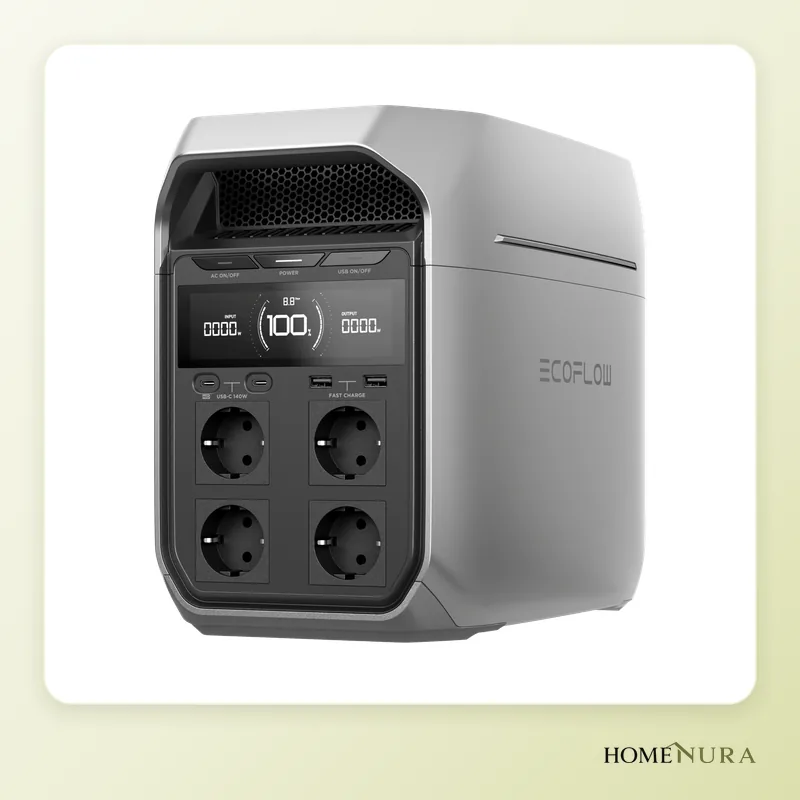
EcoFlow DELTA 3 Plus
1,024 Wh LiFePO4, 1,800 W, UPS, 1,000 W solar input and a very complete Wi-Fi/Bluetooth app: the ideal balance for home backup, the backyard and van life.
Photo: © EcoFlow
- View on Amazon →
Best value
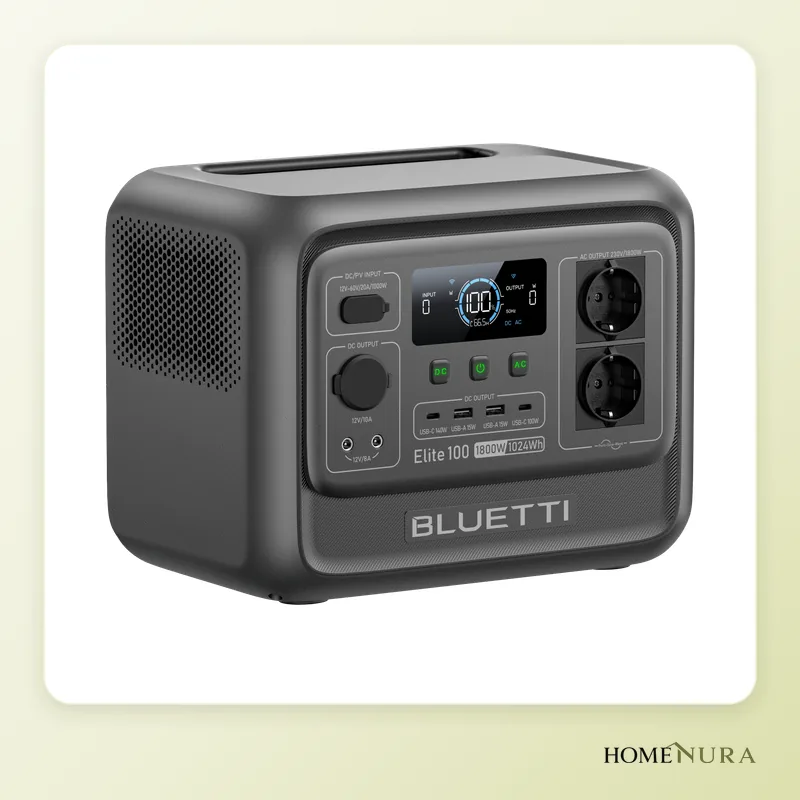
BLUETTI Elite 100 V2
Same capacity as the DELTA 3 Plus, 1,000 W solar input, 10 ms UPS switchover and 25.4 lb (11.5 kg), usually in a more affordable tier.
Photo: © BLUETTI
- View on Amazon →
Best for light camping
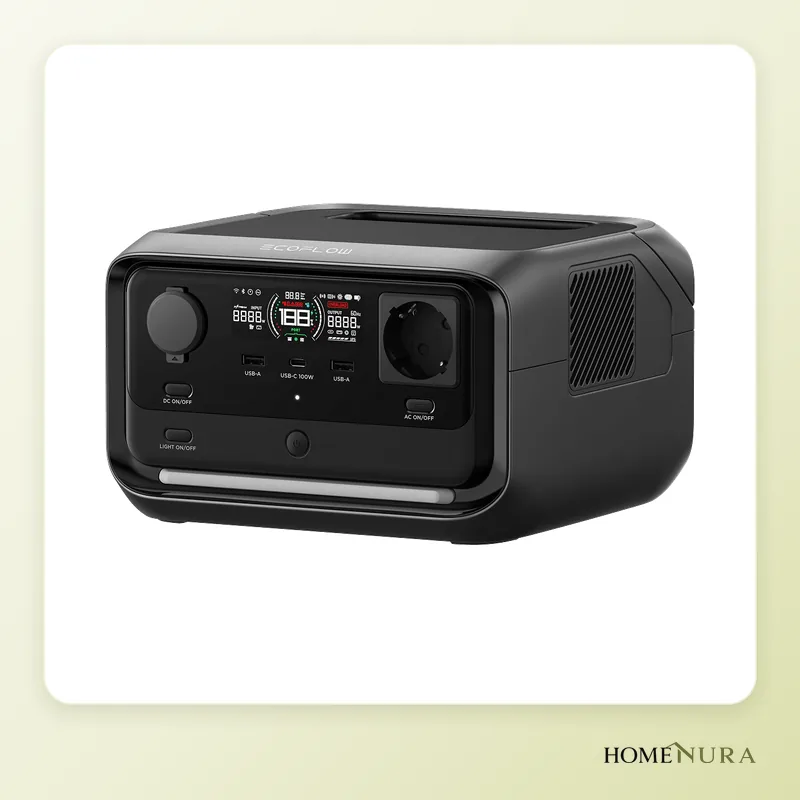
EcoFlow RIVER 3 Plus
Only 10.4 lb (4.7 kg) for 286 Wh and 600 W, sub-10 ms UPS switchover and expandable to 858 Wh: perfect for a tent or as backup power for your internet router.
Photo: © EcoFlow


As an Amazon Associate I earn from qualifying purchases. Amazon affiliate links: we earn a commission at no extra cost to you.
The best portable power station in 2026 for most households is the EcoFlow DELTA 3 Plus: a 1,024 Wh LiFePO4 battery, 1,800 W of continuous output, a UPS function and full app control over Wi-Fi and Bluetooth. If you need something lighter for camping or a van, the EcoFlow RIVER 3 Plus (286 Wh, 10.4 lb) handles small devices, while the BLUETTI Elite 100 V2 matches the DELTA 3 Plus on capacity and adds a 1,000 W solar input.
This comparison is based on manufacturer specs, published independent tests and verified owner reviews. It also shows you how to figure out how long your devices will really run, because that's where most buying mistakes happen.
Wh vs. W: the two numbers you shouldn't mix up
Every portable power station lists two headline numbers, and they measure completely different things.
- Capacity, in watt-hours (Wh): the size of the "gas tank." A 1,024 Wh battery can in theory supply 1,024 W for one hour, or 100 W for about 10 hours.
- Output power, in watts (W): the most the inverter can deliver at any one moment. A 2,000 W appliance won't start on a station limited to 1,500 W, even with a full battery.
Manufacturers also list a surge rating, which covers the inrush current of a refrigerator compressor when it kicks on, and sometimes a boost mode (X-Boost on EcoFlow, "lifting" on BLUETTI) that runs some resistive appliances above the rated output by lowering the voltage. That mode works for a kettle or hair dryer, not for sensitive electronics.
Models mentioned in this guide
- Anker SOLIX C1000 Gen 2View on Amazon →
- Jackery Explorer 1000 v2View on Amazon →
Photos: © EcoFlow, © BLUETTI
As an Amazon Associate I earn from qualifying purchases. Amazon affiliate links: we earn a commission at no extra cost to you.
How to calculate real run time
The inverter that turns the battery's direct current into household AC power (230 V on the European models covered here) uses some energy itself. Models sold in Europe are built for 230 V; check that the version on your Amazon store is rated for 120 V. In practice, about 85% of the capacity is actually available at the AC outlets (a bit more through the USB-C ports, which skip the conversion). The simple formula:
Run time (hours) ≈ capacity (Wh) × 0.85 ÷ device wattage (W)
A few examples with a 1,024 Wh station, so roughly 870 Wh usable:
- Modem and Wi-Fi router (about 15 W): 870 ÷ 15 ≈ 58 hours, more than two days online during a power outage.
- Laptop (about 60 W while charging): 870 ÷ 60 ≈ 14 hours of work.
- Compressor cooler (about 40 W on average): 870 ÷ 40 ≈ 21 hours, enough for a short weekend of van camping if you top it off a little during the day.
- Newer refrigerator (about 1 kWh a day): just under a full day, as long as the surge rating can handle the compressor start-up.
- 2,000 W electric kettle: only possible on a station that delivers 2,000 W continuously; each quart (about a liter) you boil uses roughly 0.1 kWh.
With a small 286 Wh station (about 240 Wh usable), you can charge a smartphone around 15 times or run a 10 W LED string light for about 20 hours. To find out exactly what your devices draw, a smart plug with energy monitoring is still the most reliable tool.
What to look for
LiFePO4 chemistry and cycle life
Every station in this comparison uses LiFePO4 (lithium iron phosphate, or LFP) cells. This chemistry is more thermally stable than the NMC used in older generations and lasts far more cycles: manufacturers typically quote 3,000 to 4,000 cycles before capacity drops to 70 or 80% of the original. Even with daily use, that works out to about 10 years of service. The trade-off: LFP is slightly heavier for the same capacity.
UPS mode for power outages
A UPS (uninterruptible power supply) function lets you leave the station connected full-time between the wall outlet and your devices: if the power goes out, it takes over within milliseconds. A switchover of 10 to 20 ms is fine for a router, a desktop computer or an aquarium. For medical equipment, always check with the device manufacturer and your doctor before relying on a power station.
Solar input
For off-grid use, the solar (MPPT) input rating determines how fast you recharge. With 400 W of well-angled panels, a 1 kWh station refills in a few hours of full sun; with 1,000 W, in one to two hours. Also check the accepted voltage range, since it decides how many panels you can wire in series.
Weight and size
At around 1 kWh, expect 24 to 31 lb (10.8 to 14.2 kg): you can carry that one-handed from the car to the campsite, but not down a trail. For hiking or a small car's trunk, a model under 300 Wh makes more sense.
App and connectivity
A companion app shows live power draw and remaining run time, and lets you switch off an output, limit charging speed or set a discharge floor. Over Wi-Fi, you can monitor the station remotely (handy for keeping an eye on a freezer during an outage); with Bluetooth only, you have to stay nearby.
The 6 best portable power stations of 2026
1. EcoFlow DELTA 3 Plus — best overall
The EcoFlow DELTA 3 Plus pairs a 1,024 Wh LiFePO4 battery with 1,800 W of continuous output, plus X-Boost to run some resistive appliances up to 2,400 W. It accepts up to 1,000 W of solar, charges from 0 to 80% in under 50 minutes from a wall outlet and includes a UPS function. EcoFlow rates it for 4,000 cycles before it drops below 80% capacity.
Pros: a very complete EcoFlow app over Wi-Fi and Bluetooth, 11 outputs, quiet operation, expandable to about 3 kWh with extra batteries.
Cons: 27.6 lb (12.5 kg), a little heavier than the Anker or Jackery of similar capacity.
Best for: households that want one versatile unit for power outages, the backyard and weekends in the van.
2. Anker SOLIX C1000 Gen 2 — 2,000 W in a compact body
The Anker SOLIX C1000 Gen 2 delivers 2,000 W continuously from 1,024 Wh, so it can run a kettle or a toaster oven without a reduced-voltage mode. Anker rates a full recharge from a wall outlet at 49 minutes, solar input goes up to 600 W and the UPS switches over in under 10 ms. Anker also rates it for at least 80% capacity after 4,000 cycles.
Pros: only 24.9 lb (11.3 kg) for 2,000 W, compact footprint, fast UPS, Anker app control.
Cons: lower solar input than the EcoFlow or BLUETTI.
Best for: anyone who wants to plug in kitchen appliances or power-hungry tools, at the campsite or at home.
3. BLUETTI Elite 100 V2 — the most features for the capacity
The BLUETTI Elite 100 V2 offers 1,024 Wh, 1,800 W continuous (2,700 W in lifting mode for resistive appliances) and a generous 1,000 W solar input. It weighs 25.4 lb (11.5 kg) in a body of about 0.6 cu ft (17 L), with a 10 ms UPS and a 140 W USB-C port. BLUETTI rates it for more than 4,000 cycles.
Pros: excellent solar input, a BLUETTI app over Wi-Fi and Bluetooth with Standard, Silent and Turbo charging modes, usually priced below the DELTA 3 Plus.
Cons: fewer outlets than the EcoFlow (nine outputs in all).
Best for: people who lean on solar, in the backyard or for extended off-grid stays.
4. Jackery Explorer 1000 v2 — lightest at around 1 kWh
The Jackery Explorer 1000 v2 packs 1,070 Wh into 23.8 lb (10.8 kg), the best energy density in this comparison. It puts out 1,500 W continuous (3,000 W peak), with a UPS switchover of 20 ms or less. A one-hour fast charge can be turned on in the Jackery app. The manufacturer rates it for 4,000 cycles before it drops below 70% capacity. On solar, it takes about 3.8 hours with two 200 W panels.
Pros: low weight, a brand that's widely available in Europe, a simple app with a quiet charging mode.
Cons: 1,500 W of continuous output is right at the limit for a full-power kettle or space heater; slower solar charging.
Best for: car camping and anyone who moves their station around a lot.
5. DJI Power 1000 V2 — most powerful and most expandable
The DJI Power 1000 V2 is rated at 2,600 W continuous from 1,024 Wh, the highest output in this comparison. It charges from 0 to 80% in 37 minutes, has two 140 W USB-C ports and accepts up to five expansion batteries. DJI rates it for more than 80% capacity after 4,000 cycles, and you control the station through the DJI Home app over Wi-Fi and Bluetooth.
Pros: exceptional output, very fast charging, extensive expandability, quiet operation.
Cons: 31.3 lb (14.2 kg), the heaviest here; only two AC outlets on the European version.
Best for: video creators, power tool users and anyone building an expandable energy reserve.
6. EcoFlow RIVER 3 Plus — the compact pick for light camping
The EcoFlow RIVER 3 Plus serves a different purpose: 286 Wh, 600 W continuous (1,200 W with X-Boost) and just 10.4 lb (4.7 kg). It accepts 220 W of solar, switches to UPS in under 10 ms and can grow to 858 Wh with an extra battery. EcoFlow rates it for 3,000 cycles to 80% capacity.
Pros: easy to carry, Wi-Fi and Bluetooth app, ideal as a UPS for a router or a home office.
Cons: not enough capacity to run a cooler for several days; not designed for household appliances.
Best for: road trips, music festivals, working from the backyard and keeping a router online.
Comparison table
| Model | Capacity / output | Weight | Max solar | App | Best for |
|---|---|---|---|---|---|
| EcoFlow DELTA 3 Plus | 1,024 Wh / 1,800 W | 27.6 lb (12.5 kg) | 1,000 W | Wi-Fi + Bluetooth | All-around use, outages |
| Anker SOLIX C1000 Gen 2 | 1,024 Wh / 2,000 W | 24.9 lb (11.3 kg) | 600 W | Anker app | Power-hungry appliances |
| BLUETTI Elite 100 V2 | 1,024 Wh / 1,800 W | 25.4 lb (11.5 kg) | 1,000 W | Wi-Fi + Bluetooth | Solar, backyard |
| Jackery Explorer 1000 v2 | 1,070 Wh / 1,500 W | 23.8 lb (10.8 kg) | Two 200 W panels | Jackery app | Car camping |
| DJI Power 1000 V2 | 1,024 Wh / 2,600 W | 31.3 lb (14.2 kg) | Via DJI adapter | Wi-Fi + Bluetooth | Power, expandability |
| EcoFlow RIVER 3 Plus | 286 Wh / 600 W | 10.4 lb (4.7 kg) | 220 W | Wi-Fi + Bluetooth | Light camping, router UPS |
Browse every available model in our portable power stations section.
Mistakes to avoid
- Buying on capacity alone: 1,000 Wh with 1,500 W of output will never run a 2,000 W appliance.
- Forgetting conversion losses: expect about 15% less than the rated capacity at the AC outlets.
- Overestimating solar: a 200 W panel rarely produces 200 W; panel angle, season and clouds cut output sharply.
- Ignoring weight: above 22 lb (10 kg), a station goes from the car to the campsite, not down a trail.
- Connecting the station to your home's electrical panel: back-feeding through an outlet is dangerous; any connection to your home's wiring requires a proper transfer device installed by a licensed electrician.
Safety: rain, ventilation and storage
A portable power station isn't designed for rain. Use it under a tent, an awning or inside the vehicle, away from splashes and moisture, and never set it directly on wet grass. Cables and solar panels have their own protection ratings: check them in the manual.
Always keep the vents clear: the inverter and charger heat up, especially during fast charging or at high output. Don't cover the station, don't shut it inside a closed box while it's running, and avoid long stretches in direct sun. In a van, strap it down securely so it can't turn into a projectile when you brake.
For long-term storage, most manufacturers recommend keeping the battery at around 50 to 60% and recharging it every three to six months. Stick to the charging temperature range in the manual, especially in winter: a LiFePO4 battery must not be charged when it's below the limits set by the manufacturer.
If you're pairing a station with panels, our guide to balcony solar panels explains how that differs from a grid-tied setup, and our article on smart solar outdoor lighting rounds out your outdoor gear.
The bottom line
For mixed use at home, in the backyard and in the van, the EcoFlow DELTA 3 Plus is the most balanced choice: enough capacity, a polished app, UPS and strong solar input. The BLUETTI Elite 100 V2 is a very close alternative, especially appealing if solar is at the center of your plans. If you need to run appliances of 2,000 W or more, look at the Anker SOLIX C1000 Gen 2 or the DJI Power 1000 V2. And for light camping and router backup, the EcoFlow RIVER 3 Plus gets the job done at a fraction of the weight.
Frequently asked questions
What capacity portable power station do you need?
Can a power station run a refrigerator during a power outage?
What is UPS mode on a power station?
Can you use a power station in the rain?
How long does a LiFePO4 battery last?
Can you connect a power station to your home's electrical system?
From our complete guide
Smart Yard & Outdoor →Our recommendations
- Anker SOLIX C1000 Gen 2View on Amazon →
- Jackery Explorer 1000 v2View on Amazon →
Photos: © EcoFlow, © BLUETTI
As an Amazon Associate I earn from qualifying purchases. Amazon affiliate links: we earn a commission at no extra cost to you.


